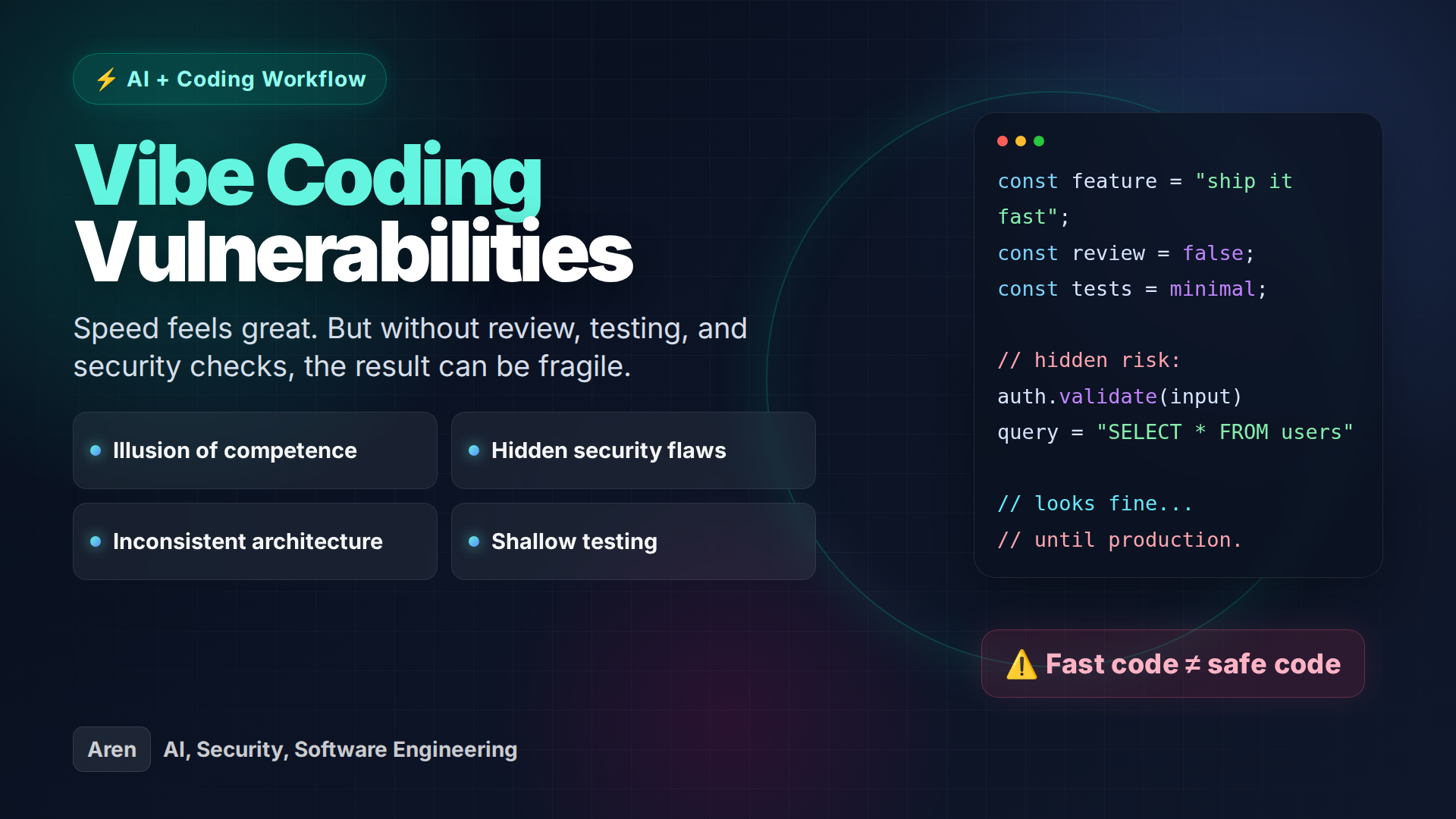
The Vulnerabilities of Vibe Coding and How to Address Them

Vibe coding has become an increasingly popular term among developers. In simple terms, vibe coding describes a way of working that heavily relies on AI to produce code quickly from intent, problem descriptions, or a desired solution direction. A developer expresses the “vibe” of what they want to build—the feature, the problem, the architecture they have in mind—and AI helps translate that into code snippets, project structure, queries, tests, and even documentation.
The appeal is obvious. Many technical tasks that once took hours can now be accelerated dramatically. But like every form of acceleration, there is a cost. The faster we move, the greater the risk if the foundation, validation, and engineering discipline do not improve alongside that speed. That is why vibe coding should not be treated merely as a more relaxed way to code, but as a working method that demands stronger quality control.
Introduction: Why Is Vibe Coding So Appealing?
There is a reason many developers quickly fall in love with vibe coding. AI creates an experience that feels like working with a pair programmer who is always available. Ideas that were once abstract can immediately become prototypes. Tedious boilerplate can be finished in minutes. Documentation, refactoring, and test generation also become easier.
For solo developers, small startups, content builders, and engineers who frequently explore new ideas, vibe coding feels like a major productivity leap. It reduces the friction between idea and implementation. In many cases, that is extremely valuable.
But precisely because the friction is lower, the guardrails can disappear as well. Code that “seems to work” is not necessarily safe, maintainable, efficient, or aligned with real business needs. This is where the vulnerabilities of vibe coding begin to show.
The Advantages of Vibe Coding
Before discussing the risks, it is only fair to acknowledge its real strengths.
1. Extremely fast prototyping
AI can produce application scaffolding, UI components, API endpoints, form validation, and deployment configuration in a very short time. For idea exploration, this is a major advantage.
2. Reduced repetitive workload
Many tasks such as building CRUD features, writing basic unit tests, drafting API documentation, or transforming data formats can be partially automated. Developers can focus more on architectural decisions and business needs.
3. Better support for learning and exploration
When trying a new framework, AI can explain common patterns, provide implementation examples, and accelerate onboarding. It helps developers learn while building.
4. Faster iteration cycles
With AI, the loop of “try–see the result–revise” becomes much faster. This is especially useful for product validation, UX experimentation, and feature iteration.
5. Greater accessibility to software creation
People with non-technical or limited technical backgrounds can now get much closer to building software. While AI does not replace experienced engineers, it does make the entry point more approachable.
The Vulnerabilities of Vibe Coding
Behind all of its advantages, vibe coding comes with serious vulnerabilities that must be understood clearly.
1. The illusion of competence
One of the biggest dangers is when developers feel they understand the system simply because they managed to produce working code. AI-generated code can look convincing even when the user does not truly understand it.
This leads to consequences such as:
- Bugs becoming harder to trace
- Refactoring turning more risky
- Growing dependency on AI
- Teams losing deep understanding of the systems they build
Vibe coding becomes dangerous when outputs are accepted without critical reading.
2. Hidden security weaknesses
AI can generate code that is functionally correct but weak from a security perspective. Examples include:
- Database queries vulnerable to SQL injection
- Incomplete input validation
- Fragile authentication handling
- Unsafe secret storage
- Error handling that leaks sensitive information
- CORS, session, or permission settings that are too permissive
The problem is that such weaknesses often do not show up in early demos. The application appears to work normally until it is exploited.
3. Inconsistent architecture quality
AI is often good at producing local solutions, but it is not always consistent at the system level. In growing projects, this may result in:
- Mixed coding patterns
- Inconsistent naming
- Confusing folder structures
- Abstractions that are either premature or missing altogether
- High coupling between modules
This may be tolerable in a prototype, but for long-term products it becomes technical debt.
4. Overengineering and code bloat
Sometimes AI is simply too eager. A simple request may be answered with an unnecessarily complex architecture, unneeded dependencies, layered helpers, and logic that is difficult to read. Instead of efficiency, the result is noise.
5. Technical hallucinations
AI may use APIs that do not exist, invalid syntax, incorrect package names, or inaccurate assumptions about how a library behaves. If a developer is too trusting, time is wasted chasing false solutions.
6. Licensing and compliance risks
In professional contexts, the origin of code also matters. Even when it is not always easy to trace, AI-assisted development still requires attention to:
- Internal company policies
- Dependency license compliance
- Leakage of sensitive data through prompts
- Use of private source code as context without adequate controls
7. Shallow testing
AI-generated code often comes with tests, but the quality of those tests is not necessarily strong. Many tests only verify happy paths and ignore edge cases, failure paths, performance, and security.
8. Erosion of engineering discipline
If every problem is immediately handed to AI, developers may lose essential habits: modeling the problem, simplifying assumptions, reading original documentation, and evaluating trade-offs. Over time, this can reduce the quality of technical decision-making.
Why Do These Vulnerabilities Happen?
The root problem is not AI itself, but the way it is used. Vibe coding becomes dangerous when:
- AI is treated as an authority rather than an assistant
- Speed is valued more than verification
- Code review is treated as optional
- Developers do not understand the domain, security model, or architecture they are building
- Prototypes are pushed into production without hardening
In other words, vibe coding is not a problem when used as an accelerator. It becomes a problem when it replaces actual thinking.
How to Address the Vulnerabilities of Vibe Coding
The good news is that these risks can be managed. The key is to establish a healthy workflow.
1. Treat AI as a drafter, not the final authority
Use AI to generate the first draft, not the final decision. Every output should be reviewed: is it correct, secure, efficient, and context-appropriate?
2. Make code review mandatory, even in personal projects
At minimum, perform a self-review with a checklist:
- Is the logic correct?
- Is all input properly validated?
- Is the error handling safe?
- Are the dependencies actually necessary?
- Will this code still be maintainable six months from now?
If the project is built by a team, do not skip peer review just because the code was “assisted by AI.”
3. Separate prototype and production phases
A prototype may be fast and rough. Production must not be. When an experiment is promoted into a real system, add a hardening phase:
- Clean up the architecture
- Add validation
- Audit authentication and authorization
- Improve logging and monitoring
- Add relevant tests
- Review performance and failure scenarios
4. Use testing as the primary guardrail
At minimum, prepare several testing layers:
- Unit tests for core logic
- Integration tests for important flows
- Security checks for input, auth, and data access
- Manual exploratory testing to confirm real application behavior
AI may help write tests, but engineers must still decide what absolutely needs to be tested.
5. Narrow the prompt scope and provide precise context
The vaguer the instruction, the wilder the AI output. A good prompt should define:
- The goal of the feature
- Technical constraints
- Security standards
- The architectural pattern in use
- The desired output format
This reduces the chance of AI generating misaligned solutions.
6. Use a basic security checklist
For every feature touching data or authentication, make it routine to check:
- Input validation
- Output sanitization
- Parameterized queries
- Secret management
- Access control
- Rate limiting where needed
- Logging without exposing sensitive data
A simple checklist is far more effective than merely assuming AI “already handled it.”
7. Preserve documentation of technical decisions
If AI helps generate code quickly, documentation becomes even more important. Record why a certain approach was chosen, not just the final result. This helps with debugging, onboarding, and refactoring.
8. Build understanding before optimizing for speed
In critical areas such as payments, authentication, data privacy, or infrastructure, do not rely only on AI output. First understand the threat model, data flows, and failure modes. Speed must not compromise integrity.
A Healthier Vibe Coding Workflow
Here is a safer and more effective working pattern:
Define the problem clearly
Write the requirements, constraints, and acceptance criteria.Use AI for the initial draft
Ask AI for structure, implementation examples, or solution options.Review critically
Read all important parts carefully. Never blindly copy and paste.Test systematically
Add tests, run failure scenarios, and check edge cases.Refactor for consistency
Align style, naming, error handling, and architectural patterns.Harden before production
Audit security, performance, and observability.
With a workflow like this, AI still provides acceleration without damaging engineering quality.
When Is Vibe Coding Appropriate, and When Should You Be Careful?
Appropriate for:
- Rapid prototyping
- Landing pages and simple internal tools
- Product idea experiments
- Learning new frameworks
- Automating repetitive developer tasks
Requires extra caution for:
- Authentication systems
- Payments and transactions
- Sensitive data processing
- Infrastructure and deployment
- Multi-tenant systems
- Applications subject to compliance or audit requirements
The higher the impact of failure, the lower the tolerance for unverified vibe coding.
Conclusion
Vibe coding is not a trend that should be rejected, but neither is it a shortcut without risk. It is a powerful acceleration tool—and like all powerful tools, its value depends on the discipline of its user.
Its strengths lie in speed, ease of exploration, and reduced repetitive workload. But its vulnerabilities are equally real: the illusion of competence, hidden security flaws, fragile architecture, shallow testing, and even the erosion of engineering judgment.
The best approach is not choosing between “use AI” or “do not use AI,” but building an engineering culture that remains strong when AI is involved. If AI is positioned as a copilot rather than an autopilot, vibe coding can be a major force multiplier. But if it is used without review, testing, or understanding, it can just as easily accelerate the creation of fragile software.
In the end, software quality is determined not by how fast code is produced, but by how well that code is understood, tested, and accounted for.