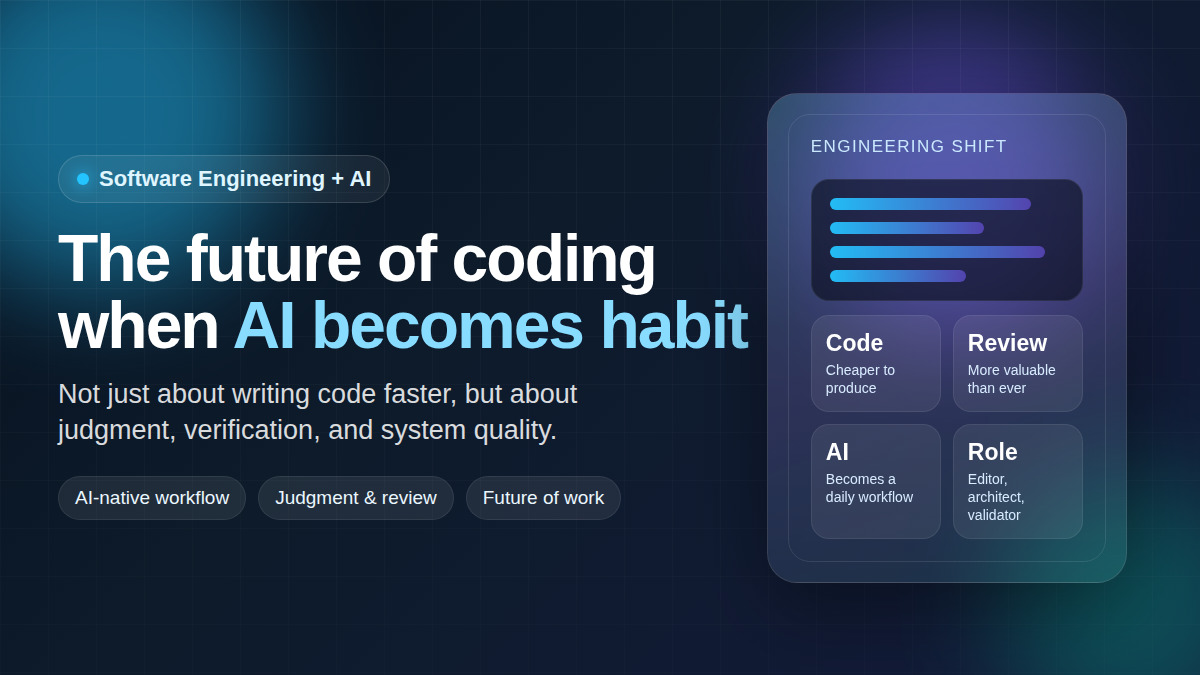
The Future of Software Engineering When AI Becomes Habit

There was a time when the ability to write code quickly was seen as one of the clearest signals of a strong engineer. Today, that measure is beginning to shift. Not because coding no longer matters, but because AI has changed our relationship with code. Writing functions, generating boilerplate, cleaning up queries, drafting basic tests, and even sketching the initial structure of an application can now be done far more quickly with generative models.
What makes this moment especially important is that the change no longer feels like a temporary experiment. In many teams, AI is no longer just an interesting new tool. It is becoming a work habit. Developers ask AI to explain documentation, draft implementations, rewrite error messages, compare approaches, and speed up refactors. Product builders use it to shrink the distance between ideas and prototypes. Founders use it to reduce the gap between concept and first product. Even engineers who remain skeptical often still rely on AI for selected tasks because it genuinely lowers friction.
So the real question is no longer whether AI will affect software engineering. It already has. The more important question is: what will software engineering look like when using AI is no longer an exception, but a default habit?
The short answer is that software engineering will not disappear, but its center of gravity will shift. The value of engineers will move away from simply typing code and further toward deeper capabilities: understanding problems, evaluating trade-offs, verifying outputs, creating guardrails, and ensuring that systems remain trustworthy even as code production becomes increasingly automated.
AI Will Reduce the Premium on Purely Mechanical Coding
AI is very good at work with clear, repeatable patterns. It can accelerate many engineering tasks that traditionally consume time without always requiring deep technical creativity. For example:
- generating project scaffolding,
- writing CRUD and basic validation,
- transforming data between formats,
- drafting initial unit tests,
- helping with syntax migrations,
- creating first-pass technical documentation,
- or explaining difficult code in simpler language.
This means that much of the coding work that is mechanical and easy to pattern-match will continue to become commoditized. Engineers who compete mainly on the speed of writing boilerplate will become harder to distinguish. In the coming years, those skills may still matter, but they will no longer be enough to define exceptional value.
What will matter more is the ability to answer questions that are much harder to automate fully: what is the actual problem? Which constraints matter most? What risks are hidden? When is a solution “good enough”? Which trade-offs are acceptable for the business, and which should never be tolerated?
In other words, AI will reduce the premium on raw code production, while increasing the premium on engineering judgment.
The Engineer’s Role Will Shift from Author to Editor, Architect, and Guardian of Truth
One of the biggest changes already becoming visible is a shift in role. In the past, engineers often acted primarily as authors: the people who wrote most of the code manually from scratch. In the era of AI-augmented coding, engineers will more often function as:
1. Editors
Engineers evaluate whether AI output is correct, sensible, secure, efficient, and aligned with team standards. Not every line needs to be written manually, but every important line still needs to be understood and consciously edited.
2. Architects
AI can help produce local solutions, but designing a coherent system still requires thinking across modules, teams, and time horizons. Decisions about domain boundaries, service contracts, observability, security posture, and scaling strategy still require a broader human perspective.
3. Guardians of truth
When code production becomes cheap, the cost of being wrong rises. That makes the engineer’s role in protecting correctness, data integrity, security, compliance, and reliability much more central.
This is an important mental shift. The engineer of the future is not a human trying to outrun AI at typing. The engineer of the future is the human who ensures that systems built with AI remain worthy of trust.
Coding Will Not Disappear, but It Will Become a More Fluid Layer
There is a common extreme narrative that says “soon everyone will just talk to AI and apps will build themselves.” It is catchy, but it oversimplifies the reality of software engineering.
It is true that the friction required to generate code will keep dropping. But valuable software is not just a collection of files that happen to run. Software used in the real world must deal with:
- changing business requirements,
- messy integrations,
- dirty data,
- unpredictable users,
- performance constraints,
- security issues,
- infrastructure costs,
- and maintenance demands over years.
AI can help with many of these areas, but the complexity of real systems does not vanish. What changes is where human effort sits. Coding will become a more fluid layer: faster to produce, easier to revise, but also more in need of verification.
The future of software engineering, then, is not a world without coding. It is a world in which coding becomes cheaper while judgment about code becomes more expensive.
Prompting Is Not the Core Skill—Problem Framing Is
There is a growing belief that the defining skill of future engineers will be “good prompting.” That is only partly true.
Prompting does matter. Clear instructions can strongly influence AI output quality. But at a deeper level, the more valuable capability is not merely writing clever prompts. It is problem framing: the ability to define the problem accurately.
Strong engineers know how to describe:
- the system objective,
- technical constraints,
- non-functional requirements,
- the threat model,
- performance limits,
- quality standards,
- and what “done” actually means.
Without correct framing, even long prompts often produce noise. In contrast, an engineer who truly understands the problem can provide concise but precise context, making AI dramatically more useful.
That is why the future of engineering will likely reward people who can define problems sharply, not just generate outputs quickly.
Verification Will Become an Increasingly Expensive and Valuable Skill
If AI makes code generation cheap, then the activity that rises in value is verification. That includes:
- checking whether logic is correct,
- ensuring edge cases are handled,
- making sure tests are meaningful,
- confirming dependencies are safe,
- verifying observability is sufficient,
- understanding failure modes,
- and validating that outputs fit business reality rather than merely compiling.
This is where the future of engineering becomes more demanding. Engineers will not be paid simply for “getting answers from AI.” They will be paid for distinguishing between answers that sound convincing and answers that are actually dependable.
In practice, this means skills like code review, testing strategy, threat modeling, performance reasoning, and systems diagnosis will become more important, not less.
Software Engineering Will Move Closer to Decision-Making Systems
As coding becomes cheaper, the bottleneck moves elsewhere. The new question is not “who can type the fastest?” but “who can make the best technical and product decisions?”
As a result, software engineering is likely to move closer to the discipline of decision-making. Strong engineers will increasingly be valued for their ability to:
- connect business needs to system design,
- simplify complexity,
- choose the right compromises,
- weigh short-term delivery against long-term consequences,
- and decide which parts of the workflow can be safely accelerated by AI and which require extreme caution.
This also means communication will become more valuable. Engineers who can explain technical reasoning, frame risks, and align decisions across stakeholders will be far more valuable than engineers who merely produce raw output quickly.
Engineering Teams Will Change, Not Just Individuals
This transformation will not happen only at the individual level. Team structures and practices will change as well.
Review will matter more than ever
If more code is generated semi-automatically, teams need sharper review mechanisms. Not just style review, but assumption review, security review, and coherence review.
Internal standards must become more explicit
When AI helps write code, teams can no longer rely only on intuition or unwritten culture. They need clear standards for architecture, naming, testing, security, observability, and deployment.
Documentation becomes a strategic asset
AI performs better when context is strong. Teams with clean documentation—ADR records, style guides, domain models, incident procedures, and test strategies—will gain much more leverage from AI.
Junior onboarding may change dramatically
AI can act as a powerful tutor for junior engineers, but it can also create an illusion of competence. Teams will need to ensure that juniors do not merely become faster at generating code, but genuinely understand why a solution is correct.
The Value of Junior and Senior Engineers Will Both Change
There is a widespread concern that AI will hit junior engineers hardest. There is truth in that concern, but the picture is more nuanced.
For juniors
Highly repetitive entry-level tasks are indeed the easiest to automate. Junior engineers can no longer rely only on the ability to complete simple tasks mechanically. But AI also creates enormous opportunity: it allows faster learning, faster experimentation, and better codebase comprehension through an always-available tutor.
That means proactive juniors who take fundamentals seriously may grow faster than previous generations did. The challenge is making sure they do not stop at “I got it working,” but progress toward “I understand why this is right.”
For seniors
Senior engineers are not automatically safe either. If their value has depended too heavily on individual coding throughput, part of that value may also erode. The senior engineer of the future will be judged even more on judgment quality, architecture, mentoring, review, decision-making, and the ability to manage socio-technical complexity.
So AI does not merely pressure the lower levels. It reshapes the definition of value at every level.
Productivity Metrics Must Be Rebuilt
In the AI era, metrics such as lines of code, number of commits, or speed of completing simple tickets will become easier to game and easier to misread. Someone may produce a huge amount of output with AI assistance while creating very little actual product value.
That is why organizations need to rethink what engineering productivity really means. Healthier metrics will be closer to:
- decision quality,
- system stability,
- learning speed,
- time from idea to validation,
- delivery reliability,
- incident reduction,
- and the team’s ability to move quickly without accumulating dangerous technical debt.
If metrics do not evolve, teams may fall into false optimization: appearing extremely fast while quietly building a fragile foundation.
The Future Is Not “AI Replaces Engineers,” but “Engineers Who Use AI Well Replace Those Who Do Not”
This sentence may sound cliché, but its core is true. The primary risk is not that AI instantly replaces all developers. The more realistic shift is competitive: engineers who know how to use AI properly will move faster, learn more broadly, and create more leverage than engineers who refuse to adapt.
But there is an important caveat. “Using AI properly” does not mean surrendering every decision to the model. In fact, it means the opposite. The strongest engineers will know when to use AI, when to constrain AI, and when AI should never be trusted without strict verification.
What Should Engineers Train Starting Now?
If this direction is correct, then several capabilities deserve higher priority.
1. Problem framing
Learn to define problems more sharply than simply writing feature requests.
2. Code review and verification
Learn to read AI output with healthy skepticism.
3. System design
Understand domain boundaries, system contracts, bottlenecks, observability, and architectural trade-offs.
4. Security and reliability thinking
The more automated code creation becomes, the more important it is to understand what can fail and what the consequences will be.
5. Communication
Be able to explain technical decisions, risks, and business consequences.
6. Learning agility
Because tools continue to change, the ability to learn quickly becomes a core asset.
7. Taste and judgment
This is hard to measure but deeply important: the ability to recognize solutions that are clean, sensible, sufficiently simple, and appropriate for the context.
Conclusion
The future of software engineering is not the destruction of the developer profession. It is a transformation of what the profession values most. When AI becomes habitual, coding will become faster, cheaper, and easier to generate. Precisely because of that, the most valuable qualities will no longer be merely the ability to type solutions, but the ability to choose, guide, verify, and stand behind those solutions.
The engineer of the future will likely write less raw code manually, but think more deeply about systems, risk, quality, and decision-making. They will more often act as editor, architect, reviewer, and guardian of reliability. Engineering teams, in turn, will depend more heavily on clear standards, strong documentation, and a culture of verification.
AI will become a habit. That is increasingly certain. But the future of software engineering will still be determined by people who know how to preserve quality in the middle of that acceleration.
In the end, great software will still not come merely from the speed of code generation, but from the maturity to understand the problem and the discipline to ensure the resulting solution is truly worthy of trust.